
Mechanically Interlocked Double-Walled Covalent Organic Framework with Cucurbit[8]Uril-Stabilized Viologen Radical Dimer
Viologen radical cation dimers encapsulated in cucurbit[8]uril cavities form a mechanically interlocked double-walled COF that retains 72% of its radical signal after 7 days in air.
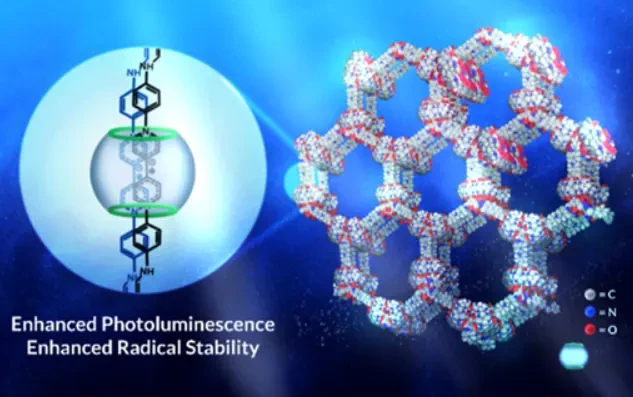
Recently, teams led by Ali Trabolsi and Serdal Kirmizialtin at New York University Abu Dhabi, in collaboration with Mohamed Eddaoudi’s group at King Abdullah University of Science and Technology, reported a radical-rich, polyrotaxanated mechanically interlocked double-walled covalent organic framework (VCB COF). Viologen radical cation dimers are encapsulated within the macrocyclic cavity of cucurbit[8]uril (CB[8]). By integrating radical π-dimerization, macrocyclic confinement, and mechanical bonds, this synergistic strategy greatly enhances radical stability under ambient conditions. This work establishes a new general paradigm for constructing crystalline materials with photoresponsiveness, redox activity, and spin functionalities.
Highlight:
In this study, viologen radical cations (V·+) were first generated by reducing viologen dications with sodium dithionite. Leveraging the ability of CB[8] to simultaneously encapsulate two guests, we precisely constructed a pseudorotaxane: CB[8]⊃(V·+)2. Subsequent Schiff-base condensation with 1,3,5-triformylphloroglucinol, followed by enol-keto tautomerization, formed β-ketoenamine linkages to yield a double-walled polyrotaxanated COF (VCB). EPR measurements confirmed that VCB retained 72% of its radical signal after 7 days in ambient air, compared to only 22% for the non-rotaxanated TpV COF—representing more than a 3-fold-fold improvement in radical stability. Simple adsorption of CB[8] failed to stabilize radicals, demonstrating that the mechanically interlocked architecture is essential for stabilization. Photovoltaic characterization revealed that VCB exhibited over 3-fold enhanced fluorescence intensity at 480 nm and generated a reversible photocurrent of 1.3 μA cm-2 under 405 nm irradiation. Transient absorption spectroscopy identified two long-lived excited-state species with lifetimes of 113 ns and 6 μs, which were insensitive to oxygen, ruling out triplet-state involvement. Structural analysis confirmed the formation of viologen radical π-dimers within the CB[8] cavity. AFM measurements showed nanosheet thickness matching the outer diameter of CB[8], corroborating the double-walled configuration. VCB demonstrated thermal stability up to 350 °C, significantly higher than the 201 °C limit for TpV. DNP-enhanced solid-state NMR, molecular dynamics simulations, and DFT calculations collectively validated the proposed structural model: the interlocked double-layer framework represents the lowest-energy configuration, with stability derived from long-range dipolar interactions and noncovalent forces within the macrocycle. This work presents a new strategy for fabricating persistent radicals in COF systems, with promising applications in energy storage, photodetectors, photoresponsive devices, and air-stable electrochromism.
Authors: Salma Abubakar, Bikash Garai, Nour Alkhatib, Rasha G. AbdulHalim, Thirumurugan Prakasam, Sudhir Sharma, Lydia Gkoura, Ribal Jabbour, Asif Equbal, Felipe Gándara, Jihan Dhainy, Devin Thrush, Claudia E. Avalos, Gobinda Das, Sharath Kandambeth, Na'il Saleh, Ramesh Jagannathan, Mark A. Olson, Mohamad El-Roz, Serdal Kirmizialtin*, Mohamed Eddaoudi*, Ali Trabolsi*
DOI: 10.1021/jacs.6c01520
Related Products
More research updates
- Huaqiao University & Xiamen Institute: CB[7] Supramolecular Confinement Strategy for Synergistic Fe Single-Atom and Cluster ORR ElectrocatalystAngewandte Chemie International Edition
- Syracuse University's Professor Xiaoran Hu: A cucurbit[7]uril–adamantane noncovalent click-to-release strategy enables a new pathway for supramolecular bioorthogonal activation.Angewandte Chemie International Edition
- Tsinghua University Team Publishes Breakthrough CB[7] Supramolecular Nanopore Anion-Conducting Membrane in NatureNature
- Jilin University Team Publishes Breakthrough CB[8] Supramolecular Confinement Self-Sensitized Photooxidation in JACSJournal of the American Chemical Society (JACS)
Related background materials
- Cucurbituril structure and binding mechanismHow the rigid glycoluril skeleton, hydrophobic cavity, and carbonyl portals collectively govern affinity and selectivity.
- Cucurbiturils vs. Other Macrocyclic HostsDifferences in cavity size, affinity range, and portal groups compared to cyclodextrins, calixarenes, and pillararenes.
- Water-soluble modified cucurbituril seriesThree solubility strategies and the systems each is designed for.
- Custom synthesis serviceSubmit a request when replicating a special substitution pattern from a paper or scaling up.